15 Best AI Tools for Digital Marketing in 2026: Features, Uses and Limitations
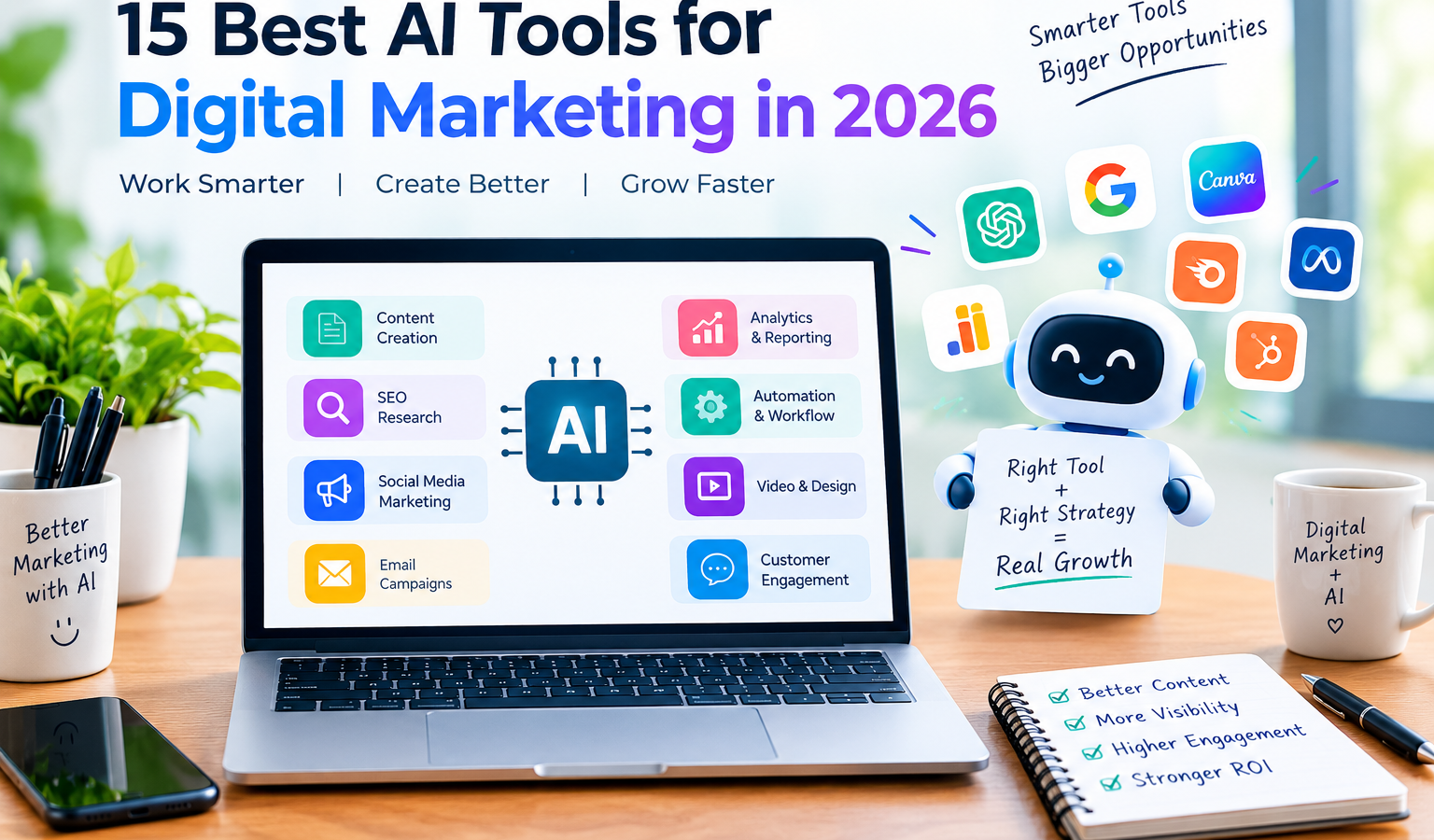
Digital marketing is changing rapidly, and artificial intelligence (AI) is becoming a valuable part of modern marketing strategies. From writing blog posts to creating social media designs, analyzing campaign performance, and improving SEO, AI tools can help marketers work more efficiently.
However, choosing the right tool can be confusing. With so many options available, businesses need to understand which tools fit their goals, budget, and marketing needs.
In this guide, we explore 15 AI tools for digital marketing in 2026, their practical uses, and how to choose the right tools for your business.
What Are AI Tools for Digital Marketing?
AI tools for digital marketing are software applications that use artificial intelligence to support tasks such as content creation, keyword research, advertising, customer communication, and data analysis.
For example, a small business can use AI to generate blog ideas, design social media posts, identify relevant keywords, and summarize campaign results.
These tools can reduce repetitive work and help teams explore new ideas. However, they still require human judgment, fact-checking, and strategic direction.
15 Best AI Tools for Digital Marketing
1. ChatGPT — Content Creation and Marketing Ideas
ChatGPT can help marketers brainstorm blog topics, develop content outlines, draft social media captions, and create email campaign ideas.
Best for: Content planning, writing assistance, brainstorming, and campaign development.
Limitation: Generated content may contain errors or generic suggestions. Review the output and add your own expertise before publishing.
2. Google Gemini — Research and Productivity
Google Gemini can assist with brainstorming, summarizing information, and developing marketing ideas. Its available features may also support workflows connected to Google products.
Best for: Research assistance, idea generation, and productivity.
Limitation: Verify important claims and check whether the features you need are available in your account.
3. Canva — AI-Assisted Graphic Design
Canva helps marketers create social media graphics, presentations, promotional materials, and other visual content. Its AI-powered features can assist with design and content workflows.
Best for: Small businesses, social media managers, and non-designers.
Limitation: Review layouts, text, image rights, and brand consistency before publishing.
4. Semrush — SEO Research
Semrush offers SEO and digital marketing tools that help users research keywords, analyze competitors, and monitor website performance.
Best for: SEO specialists, content marketers, and agencies.
Limitation: Keyword and traffic figures are estimates, not guarantees of actual search volume or future rankings.
5. Ahrefs — Keyword and Competitor Analysis
Ahrefs provides tools for researching keywords, analyzing backlinks, exploring competitors, and auditing websites.
Best for: Website owners, SEO professionals, and bloggers.
Limitation: Some features require paid plans, and third-party traffic estimates may differ from actual website analytics.
6. Grammarly — Writing and Editing
Grammarly helps users improve grammar, spelling, clarity, and tone. Depending on the plan, it may also offer AI-assisted writing features.
Best for: Blog writers, marketers, and business communication.
Limitation: Automated suggestions may not always preserve your intended meaning or brand voice.
7. HubSpot — CRM and Marketing Automation
HubSpot provides customer relationship management (CRM) and marketing tools. Its AI features can support tasks such as content development, customer engagement, and sales workflows.
Best for: Businesses managing leads, customer relationships, and marketing campaigns.
Limitation: Advanced capabilities may require paid subscriptions or specific product tiers.
8. Mailchimp — Email Marketing
Mailchimp supports email campaign creation, audience management, and marketing automation. Depending on the plan, AI-assisted features may help with email content and campaign workflows.
Best for: Small businesses, online stores, and email marketers.
Limitation: Results depend on list quality, campaign relevance, deliverability, and audience engagement.
9. Jasper — Marketing Content
Jasper focuses on AI-assisted marketing content and brand-oriented writing workflows.
Best for: Marketing teams that produce campaign copy and branded content at scale.
Limitation: Review all content for originality, accuracy, and consistency with your brand guidelines.
10. Copy.ai — Marketing Copy and Workflows
Copy.ai supports AI-assisted copywriting and business workflows, depending on the product and plan.
Best for: Teams creating marketing messages, sales copy, and campaign drafts.
Limitation: Generated copy still needs audience research, editing, and factual review.
11. Google Ads AI Features — Advertising Optimization
Google Ads includes AI-powered capabilities that can assist with campaign optimization, bidding, targeting, and creative workflows, depending on the campaign type.
Best for: Businesses running paid search and other Google advertising campaigns.
Limitation: Automation does not eliminate the need to monitor spending, conversion quality, targeting, and return on ad spend.
12. Meta Advantage+ — Social Advertising
Meta Advantage+ uses automation across supported advertising workflows on Facebook and Instagram.
Best for: Advertisers looking to streamline campaign setup and optimization.
Limitation: Results depend on creative quality, conversion tracking, audience signals, and campaign settings.
13. Surfer — Content Optimization
Surfer provides content optimization tools that help writers evaluate how their pages align with relevant search topics and competing content.
Best for: SEO content teams and bloggers.
Limitation: Do not follow content scores blindly. Reader needs, accuracy, originality, and clarity matter more than achieving a particular score.
14. Descript — Audio and Video Editing
Descript supports audio and video editing workflows, including text-based editing and AI-assisted features.
Best for: Video marketers, podcasters, and teams repurposing long-form content.
Limitation: Check edited footage, captions, audio quality, and permissions before publication.
15. Zapier — Workflow Automation
Zapier connects supported apps and automates repetitive tasks. AI-related capabilities can help teams build workflows across compatible services.
Best for: Marketing teams that want to reduce manual work between tools.
Limitation: Test workflows carefully, especially when they handle customer information, payments, or automated communications.
Note: Features, integrations, and pricing can change. Check each provider’s official website before choosing a subscription.
How to Choose the Right AI Marketing Tool
You do not need all 15 tools to build an effective digital marketing strategy. Start with the tasks that consume the most time or create the biggest bottlenecks.
Use this simple approach:
- Define your goal. Decide whether you need better content, stronger SEO, improved advertising, or more efficient reporting.
- Set a budget. Compare free plans, paid features, usage limits, and subscription costs.
- Test a small workflow. Try one tool on a real task before committing to a long-term subscription.
- Measure the results. Track time saved, content quality, qualified leads, conversions, or campaign performance.
- Protect customer data. Review privacy policies and avoid uploading confidential information without proper authorization.
For example, a beginner blogger might start with ChatGPT for planning, Canva for graphics, and Google Search Console for SEO performance monitoring. An advertising team may need different tools for campaign optimization and reporting.
Benefits of AI Tools in Digital Marketing
When used appropriately, AI tools can help marketers:
- Generate and organize content ideas faster.
- Support keyword research and competitor analysis.
- Create visual content and campaign variations.
- Automate repetitive marketing tasks.
- Summarize performance data for further analysis.
- Improve productivity while leaving strategic decisions to people.
The key is to use AI to support marketing expertise rather than replace it.
Common Mistakes to Avoid
Avoid publishing AI-generated content without checking its accuracy. Do not assume that automated campaigns will always improve performance, or that a tool’s recommendations guarantee higher rankings.
Google’s guidance emphasizes helpful, reliable, people-first content rather than content created primarily to manipulate search rankings. AI can support content creation, but original value and human review remain essential.
Frequently Asked Questions
Which AI tool is best for digital marketing?
There is no single best tool for every business. ChatGPT can support content planning, Canva can help with design, and Semrush or Ahrefs can support SEO research. Choose based on your specific needs.
Are AI marketing tools suitable for beginners?
Yes. Many tools offer beginner-friendly interfaces and free or entry-level options. Start with one or two tools and learn their limitations before expanding.
Can AI tools replace digital marketers?
AI can automate or assist with certain tasks, but marketers still need to understand customer needs, develop strategy, assess accuracy, and make business decisions.
Are free AI marketing tools enough?
Free tools may be sufficient for basic content creation, design, and research. More advanced workflows may require paid plans, depending on usage and feature requirements.
Conclusion
AI tools for digital marketing in 2026 can help businesses improve productivity, develop content, research SEO opportunities, and manage campaigns more efficiently. However, success depends on selecting the right tools and using them with a clear strategy.
Start small, test tools against real marketing goals, and measure what improves your work. Combine AI assistance with human creativity, reliable data, and careful review to build a more effective digital marketing process.